Industry Insights
Conformal cooling and 3D-printed inserts in mould making
By DIEMEX Team ·
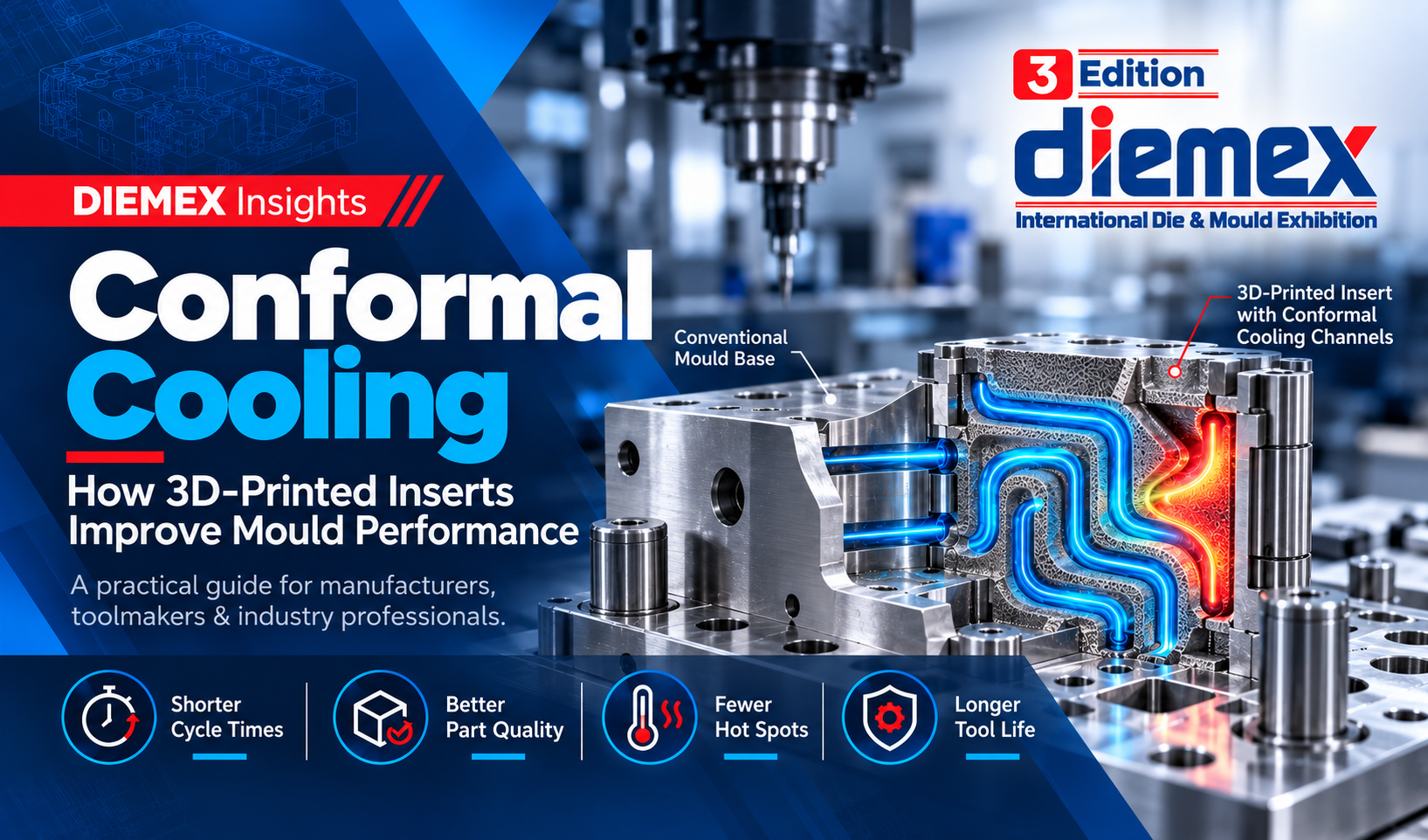
Conformal cooling and 3D-printed inserts help mould makers cut cycle times, reduce warpage and extend tool life. Here’s how the technology works and where it pays off.
DIEMEX Insights | International Die & Mould Exhibition, 3rd Edition
In injection moulding and die casting, cooling decides a lot: cycle time, part quality, warpage and tool life. For decades, cooling channels have been drilled in straight lines, because that is what conventional machining allows. Conformal cooling changes this. By using metal 3D printing to build inserts with channels that follow the shape of the part, mould makers can cool where it matters most.
This article explains what conformal cooling is, how 3D-printed inserts work, where they deliver value, and what Indian tooling makers should consider before adopting them.
What is conformal cooling? Conformal cooling uses cooling channels that follow the contour of the mould cavity or core, instead of running in straight drilled lines. The channels can curve, branch and change cross-section, so coolant stays at a consistent distance from the part surface.
Conventional drilled channels struggle in areas such as deep cores, thin ribs, tight corners and complex geometries. These areas become hot spots that slow the cycle and cause defects.
How 3D-printed inserts make it possible
Metal additive manufacturing, such as laser powder bed fusion, builds tool steel inserts layer by layer. Because the channels are built into the insert, designers are free to create internal passages that cannot be drilled or milled.
In practice, most moulds do not need to be fully printed. The common approach is a hybrid tool: a conventionally machined mould base and body, with 3D-printed inserts placed only in the critical areas that need better cooling. This keeps cost and lead time under control.
Key benefits for mould makers and moulders
- Shorter cycle times: Faster, more uniform heat removal can reduce cooling time, which is often the longest part of the cycle.
- Better part quality: More even cooling reduces warpage, sink marks and internal stresses, and improves dimensional consistency.
- Fewer hot spots: Targeted cooling in difficult areas improves surface finish and reduces rejections.
- Longer tool life: Reduced thermal stress and more stable temperatures help protect the tool.
- Design freedom: Features such as lattice structures, variable channel shapes and integrated sensor positions become possible.
The actual gain depends on the part, material and process, so results should be validated with simulation and trials rather than assumed.
Where conformal cooling works best
- Parts with deep cores, tall bosses or thin walls
- High-volume production, where even small cycle-time savings add up
- Tight-tolerance parts that are prone to warpage
- Die casting dies with severe hot spots and heat checking
- Parts for automotive, EV, medical, electronics and consumer products
For low-volume, simple parts, conventional cooling is often still the better economic choice.
Challenges to plan for Cost. Printed inserts cost more than conventional ones. The business case rests on cycle-time savings, quality gains and reduced scrap over the production run. Design skill. Good conformal cooling needs thermal simulation and design-for-additive knowledge, not just copying existing channels into a printed shape. Material and surface finish. Printed inserts may need post-processing such as heat treatment, machining, polishing and surface finishing to meet cavity requirements. Channel cleaning and maintenance. Complex internal channels can be harder to clean. Water quality and flushing routines matter. Supplier ecosystem. Many Indian toolmakers will start by partnering with a metal 3D-printing service provider before investing in their own machines.
How to get started
- Identify the problem tools. Look for moulds or dies with long cooling times, hot spots or recurring warpage.
- Run cooling simulation. Compare conventional and conformal designs to estimate the benefit.
- Start with a hybrid insert. Print only the critical region and keep the rest conventional.
- Measure the results. Track cycle time, rejection rate and tool life against the baseline.
- Scale what works. Build in-house skills or a trusted supplier partnership once the value is clear.
See it live at DIEMEX 2027
Additive manufacturing, simulation software, machine tools and mould-making technologies are best evaluated in person. DIEMEX 2027, India's International Die & Mould Exhibition, brings suppliers and technology providers together under one roof. Dates: 24-26 March 2027 Venue: Auto Cluster Exhibition Centre, Chinchwad, Pune Organiser: Maxx Business Media Pvt. Ltd. Register as a visitor: https://www.diemex.in/register?t=visitor
Key takeaways
- Conformal cooling follows the shape of the part, removing hot spots that drilled channels cannot reach.
- 3D-printed inserts make these channels possible, usually in a hybrid tool with a conventional base.
- Benefits include faster cycles, better part quality and longer tool life, but they need to be validated for each application.
- Start small with problem tools, simulate first and measure the results.
- DIEMEX 2027 is a good place to compare technologies and meet suppliers.