
Industry Insights
How to Choose the Right Die & Mould Manufacturer
By DIEMEX Team ·
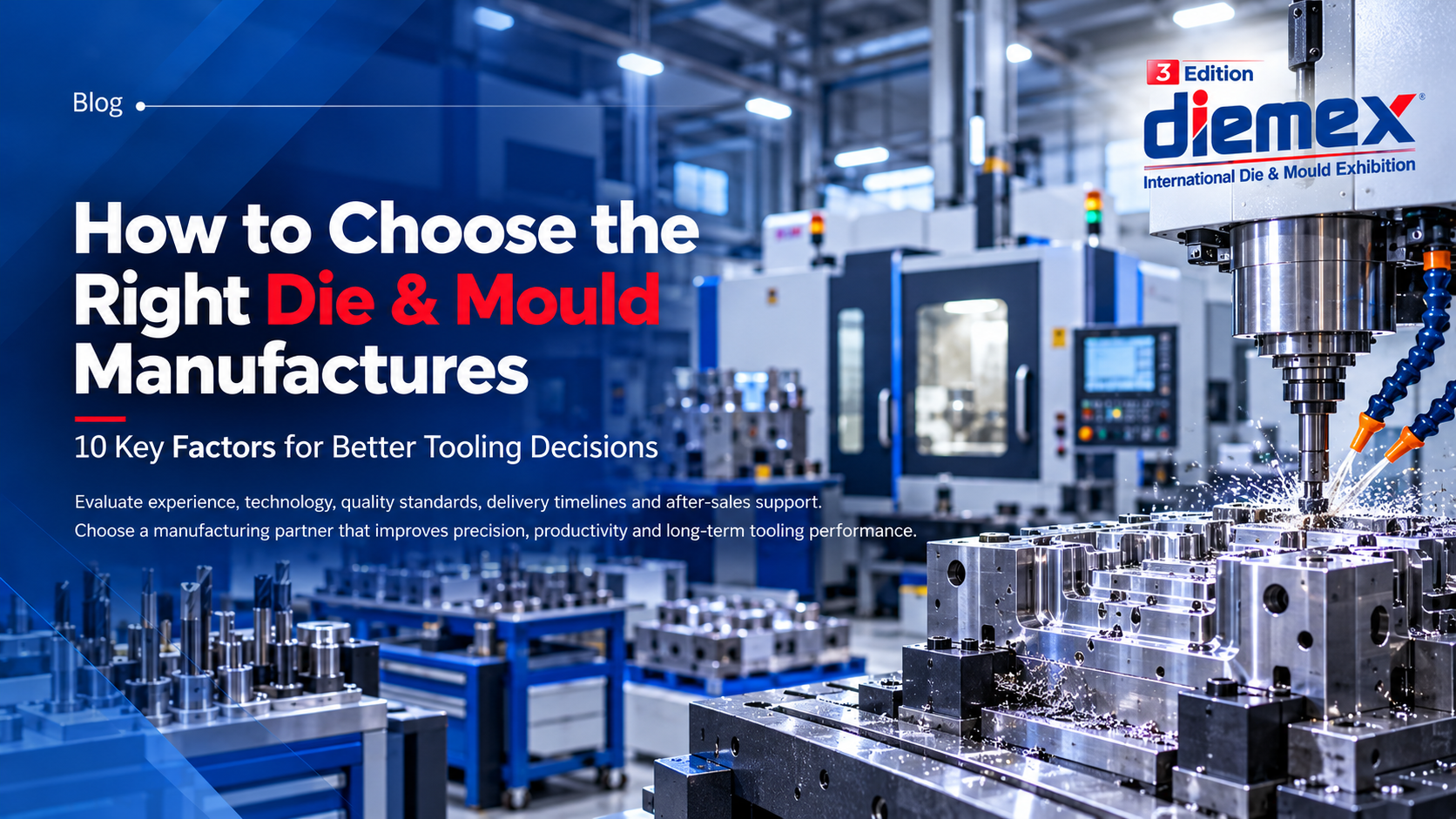
Discover the 10 key factors for choosing the right die & mould manufacturer in India, including industry experience, manufacturing technology, quality standards, and tooling costs. Learn how to evaluate suppliers for precision, durability, timely delivery, and reliable after-sales support.
Choosing the right die and mould manufacturer in India is an important decision for businesses involved in automotive, plastics, electronics, consumer goods, medical devices, aerospace, and other manufacturing industries. The quality of a die or mould directly affects product accuracy, production efficiency, cycle time, tooling costs, and overall manufacturing performance.
With hundreds of die mould manufacturing companies in India, selecting the right manufacturing partner can be challenging. Companies need to evaluate technical capabilities, manufacturing technology, quality standards, experience, delivery timelines, customization capabilities, and after-sales support before making a decision.
This guide explains the key factors to consider when choosing the right die and mould manufacturer in India.
What Is a Die & Mould Manufacturer? A die and mould manufacturer designs and manufactures precision tooling used to produce components and products in large quantities. Depending on the industry and application, manufacturers may specialize in injection moulds, die-casting dies, stamping dies, progressive dies, blow moulds, compression moulds, prototype tooling, and other customized tooling solutions. A reliable die mould manufacturer in India should be capable of converting engineering designs and product requirements into accurate, durable, and production-ready tooling
Why Choosing the Right Die & Mould Manufacturer Matters
The right tooling partner can significantly improve manufacturing performance.
A high-quality die or mould can help businesses achieve:
- Better dimensional accuracy
- Consistent product quality
- Faster production cycles
- Reduced rejection rates
- Longer tool life
- Lower maintenance costs
- Improved production efficiency
- Faster product development
- Reduced overall tooling costs
On the other hand, choosing an inexperienced manufacturer may result in dimensional problems, premature tool wear, production delays, higher maintenance costs, and expensive modifications.
10 Factors to Consider When Choosing a Die & Mould Manufacturer in India
1. Check the Manufacturer's Industry Experience
Experience is one of the first factors to evaluate when selecting a die and mould manufacturer in India.
Look for manufacturers with experience in your specific industry and tooling application. Automotive, medical, electronics, consumer products, aerospace, and industrial components may have different tooling requirements.
Ask potential manufacturers about:
- Years of experience
- Industries served
- Types of dies and moulds manufactured
- Previous projects
- Production capabilities
- Complex tooling experience
A manufacturer with relevant industry experience is more likely to understand application-specific challenges and deliver suitable tooling solutions.
2. Evaluate Design and Engineering Capabilities A good manufacturer should have strong engineering and design capabilities in addition to machining expertise.
Ask whether the company has experience with:
- 3D CAD design
- Mold flow analysis
- Product design evaluation
- Tool design
- Engineering simulations
- DFM – Design for Manufacturing
- Prototype development
- Tool optimization
Modern CAD/CAM and simulation technologies can help identify potential tooling problems before manufacturing begins.
3. Look at the Manufacturing Technology Technology plays a major role in modern die and mould manufacturing. Before selecting a supplier, evaluate the machinery and technologies available at the facility.
Important technologies may include:
- CNC machining
- High-speed machining
- EDM
- Wire EDM
- CNC grinding
- 5-axis machining
- Coordinate Measuring Machines (CMM)
- Laser measurement
- Precision inspection systems
- Automated manufacturing systems
Advanced manufacturing technology can help manufacturers achieve higher accuracy, repeatability, and surface quality.
4. Verify Quality Control Systems Quality control is critical when selecting a precision die mould manufacturer. Ask the manufacturer about its inspection and quality assurance processes.
A professional manufacturer should have systems for:
- Incoming material inspection
- Dimensional inspection
- In-process inspection
- Final inspection
- Tool testing
- Trial production
- Documentation and reporting
You should also check whether the company follows relevant quality management standards and maintains proper inspection records.
5. Check the Quality of Materials Used The quality of the steel and other materials used in a die or mould directly influences its durability and performance. Depending on the application, manufacturers may use different grades of tool steel, stainless steel, aluminium, copper alloys, and other engineering materials.
Ask about:
- Material grade
- Material certificates
- Heat treatment
- Surface treatment
- Hardness
- Corrosion resistance
- Expected tool life
A reliable die mould manufacturer in India should be transparent about material selection and provide appropriate documentation.
6. Evaluate Tool Life and Maintenance Requirements A die or mould is a long-term manufacturing asset. Therefore, don't evaluate a supplier only on the initial tooling price. Consider the expected tool life and maintenance requirements.
Ask:
- How many production cycles is the tool designed for?
- What maintenance is required?
- Are spare components available?
- How quickly can repairs be completed?
- Does the manufacturer provide maintenance support?
- Can the manufacturer modify or upgrade the tool later?
A slightly higher initial investment can sometimes provide a lower total cost of ownership over the tool's operating life.
7. Check Production Capacity and Lead Time Delivery delays can affect product launches and production schedules.
Before placing an order, confirm the manufacturer's:
- Current production capacity
- Typical tooling lead time
- Machine availability
- Project management process
- Testing and trial schedule
- Delivery commitments
Choose a manufacturer that can realistically meet your required timeline rather than selecting a supplier based only on the lowest quotation.
8. Review Previous Projects and Customer Experience A manufacturer's previous work can provide valuable information about its capabilities.
Ask for examples of similar projects and, where appropriate, review:
- Tooling samples
- Case studies
- Customer industries
- Project complexity
- Tool specifications
- Quality performance
- Delivery performance
This helps you determine whether the manufacturer has successfully handled projects similar to yours.
9. Compare Cost, Not Just the Quotation Price is important, but the cheapest quotation is not always the most economical option.
When comparing die and mould manufacturers in India, consider the total cost, including:
Tooling Cost + Maintenance + Downtime + Repairs + Tool Life + Production Efficiency
A low-cost mould that requires frequent repairs may ultimately cost more than a higher-quality tool with longer service life. Therefore, evaluate the manufacturer's overall value rather than comparing only the initial quotation.
10. Evaluate After-Sales Support Tooling support doesn't end when the die or mould is delivered.
Choose a manufacturer that provides reliable after-sales support for:
- Tool maintenance
- Repairs
- Spare components
- Tool modifications
- Troubleshooting
- Production support
- Performance optimization
Strong technical support can reduce downtime and help maintain consistent production quality.