

Industry Insights
Why Quality Standards Matter in Die and Mould Manufacturing
By DIEMEX Team ·
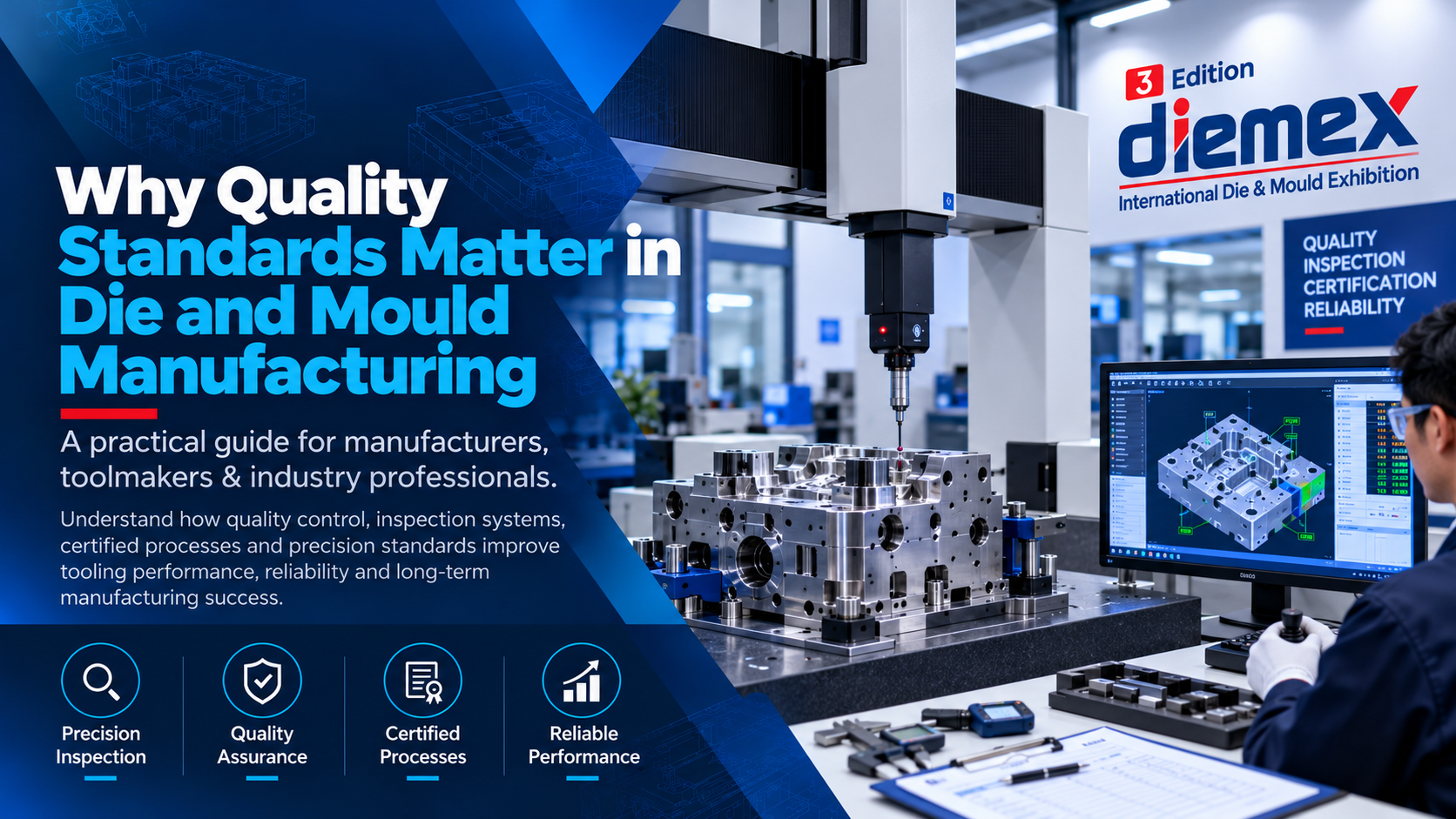
Quality standards in die and mould manufacturing ensure precision, consistent product quality, longer tool life, reduced production costs, and reliable performance. Discover how effective quality control helps manufacturers improve efficiency and meet industry requirements
Quality standards are the foundation of reliable die and mould manufacturing. They help manufacturers maintain dimensional accuracy, improve product consistency, reduce production defects, and deliver durable tooling solutions. In industries such as automotive, electronics, medical devices, packaging, and industrial engineering, even minor tooling inaccuracies can affect product quality and manufacturing efficiency.
As India's manufacturing sector continues to adopt advanced technologies, choosing a die and mould manufacturer that follows robust quality control practices is increasingly important. Understanding the role of quality standards can help businesses select the right manufacturing partners and achieve better long-term production results.
What Are Quality Standards in Die and Mould Manufacturing?
Quality standards in die and mould manufacturing are defined requirements, procedures, and inspection practices used to ensure that dies, moulds, and tooling components meet the required specifications.
These practices cover the entire manufacturing process, from material selection and mould design to machining, assembly, testing, and final inspection. Common quality control activities include:
- Dimensional inspection: Verifying that mould components meet specified measurements and tolerances.
- Material testing: Checking material properties, hardness, and suitability for the intended application.
- Surface finish inspection: Ensuring mould surfaces meet the required finish and functional requirements.
- Process monitoring: Maintaining consistency during CNC machining, EDM, grinding, and other manufacturing operations.
- Tool validation: Testing moulds and dies to confirm that they perform as expected under operating conditions.
- Documentation and traceability: Maintaining inspection records, material certificates, and process documentation where required.
Depending on the application, manufacturers may work with relevant ISO quality management standards, customer-specific requirements, and industry-specific specifications.
7 Reasons Why Quality Standards Matter in Die and Mould Manufacturing?
1. Improve Dimensional Accuracy and Precision Precision is one of the most important requirements in die and mould manufacturing. Components must meet specified dimensions, tolerances, and geometric requirements to ensure proper fit and function. Quality control practices help manufacturers identify deviations during CNC machining, electrical discharge machining (EDM), grinding, and mould assembly. Accurate tooling can help produce components with consistent dimensions, reduce fitting issues, and improve the reliability of the manufacturing process.
2. Ensure Consistent Product Quality A well-designed and accurately manufactured mould helps manufacturers produce repeatable results across production runs. Without effective quality control, variations in tooling dimensions, material properties, or processing conditions can lead to defects such as flash, dimensional variation, poor surface finish, and incomplete mould filling. By monitoring critical parameters and conducting regular inspections, manufacturers can improve consistency and reduce avoidable production problems.
3. Reduce Manufacturing Defects and Rework Manufacturing defects can increase material waste, labour costs, downtime, and delivery delays. Quality standards encourage manufacturers to identify potential problems early rather than discovering them after production has started. Inspection at key stages—including raw material verification, machining, assembly, and trial runs—helps detect issues before they become more expensive to correct. Effective quality management can therefore reduce rework, scrap, and unnecessary production interruptions.
4. Increase Tool Life and Durability The performance of a die or mould depends on factors such as material selection, heat treatment, surface condition, design, operating conditions, and maintenance. Quality control helps verify that tooling materials and manufacturing processes meet the requirements of the intended application. Appropriate material selection, controlled heat treatment where applicable, accurate machining, and proper maintenance can contribute to longer tool life and more reliable performance. For manufacturers using moulds and dies in high-volume production, tooling durability can have a significant impact on operating costs.
5. Improve Production Efficiency and Reduce Costs Poor-quality tooling can result in frequent adjustments, machine stoppages, rejected components, and unexpected maintenance. By contrast, well-manufactured tooling can support smoother production, more predictable cycle times, and fewer interruptions caused by tooling-related issues. Although rigorous quality control may require additional inspection time and investment, preventing defects can help reduce the total cost of manufacturing over the life of the tool.
6. Support Customer Satisfaction and Business Growth Customers expect tooling suppliers to deliver products that meet agreed specifications, quality requirements, and delivery schedules. Manufacturers that maintain documented quality processes and consistent inspection practices are better positioned to demonstrate their capabilities to customers. Reliable quality can strengthen customer relationships, support repeat business, and help die and mould manufacturers compete for demanding industrial projects.
7. Help Meet Industry and Customer Requirements Different industries have different quality and documentation requirements. Automotive, electronics, medical device, and other precision manufacturing applications may require additional controls depending on the product and customer specification. For example, ISO 9001 provides a framework for quality management systems across different types of organizations. Automotive suppliers may also encounter IATF 16949 requirements, while other sectors may require their own industry-specific controls. Certification alone does not guarantee that every tool or component is defect-free. Manufacturers must still apply appropriate inspection, process control, testing, and corrective actions to meet the requirements of each project.
Key Quality Control Methods Used in Die and Mould Manufacturing
Modern die and mould manufacturers use a combination of inspection equipment, manufacturing technologies, and process controls to maintain quality. CNC Machining and Process Control Computer Numerical Control (CNC) machining enables precise and repeatable manufacturing of mould cavities, cores, and other tooling components. Correct programming, machine calibration, tool condition, and inspection are important for achieving the required accuracy.
Coordinate Measuring Machines (CMM) A Coordinate Measuring Machine measures component geometry and dimensions to verify whether parts meet specified tolerances. CMM inspection is particularly useful for complex mould components and precision tooling.
Electrical Discharge Machining (EDM) EDM is used to machine electrically conductive materials where complex shapes, fine features, or difficult-to-machine geometries are required. Electrode condition, machining parameters, and surface inspection help support the required results.
Material and Hardness Testing Material verification and hardness testing help determine whether tooling materials and heat-treated components meet the required specifications. The appropriate tests depend on the material, application, and engineering requirements.
Mould Trials and Validation Trial runs help manufacturers assess mould filling, component dimensions, surface finish, and other performance characteristics. Any identified issues can then be corrected before full-scale production, according to the agreed validation process.
How to Choose a Quality-Focused Die and Mould Manufacturer
Selecting the right die and mould manufacturer is essential for achieving consistent quality and dependable tooling performance. Before making a decision, consider the following factors:
- Quality management system: Ask about documented quality procedures and relevant certifications.
- Manufacturing capabilities: Review CNC machining, EDM, grinding, inspection equipment, and other capabilities required for your project.
- Inspection and testing: Understand how the supplier verifies dimensions, material properties, and finished tooling performance.
- Material and heat treatment controls: Confirm how materials and any required heat treatment processes are verified.
- Industry experience: Evaluate the supplier's experience with similar components, tooling applications, and technical requirements.
- Delivery and after-sales support: Check project planning, maintenance assistance, repair services, and technical support.
- Customer-specific compliance: Confirm the supplier can meet your drawings, tolerances, documentation, and applicable industry requirements.
The Future of Quality in Die and Mould Manufacturing
Advances in digital manufacturing are creating new opportunities to improve quality management in die and mould production. Technologies such as automated inspection, digital measurement systems, CAD/CAM integration, simulation software, machine monitoring, and data-driven process control can help manufacturers identify problems earlier and improve process consistency. As manufacturers adopt these technologies, integrating quality assurance throughout the production process—not only during final inspection—will remain essential. Continuous improvement, employee training, equipment maintenance, and reliable process documentation are equally important for achieving consistent manufacturing outcomes.
Discover Die and Mould Manufacturing Innovations at DIEMEX 2027
Quality, precision, and productivity are central to the future of die and mould manufacturing. Understanding quality standards helps manufacturers evaluate suppliers, improve production processes, and identify opportunities for better tooling performance. DIEMEX 2027 – International Die & Mould Exhibition in India will bring together industry participants from the die, mould, tooling, and advanced manufacturing ecosystem. The exhibition offers an opportunity to explore manufacturing technologies, connect with industry professionals, and discover solutions relevant to precision engineering and tooling applications.
Event details:
Dates: 24–26 March 2027 Venue: Auto Cluster Exhibition Centre, Pune, India Interested in exhibiting? Explore exhibitor registration. Planning to attend? Explore visitor registration.
Frequently Asked Questions
Why is quality control important in die and mould manufacturing? Quality control helps verify dimensional accuracy, material properties, surface finish, and tooling performance. It can reduce defects, rework, and production interruptions while supporting consistent product quality.
Which quality standards are relevant to die and mould manufacturers? ISO 9001 is a widely used quality management system standard. Depending on the industry and customer, manufacturers may also need to meet additional standards, specifications, or sector-specific requirements.
How does quality affect mould life? Material quality, heat treatment, design, machining accuracy, operating conditions, and maintenance all influence mould life. Appropriate quality controls help verify these factors and support reliable tooling performance.
What should businesses check before choosing a die and mould manufacturer? Businesses should assess technical capabilities, quality processes, inspection equipment, relevant experience, material controls, delivery reliability, and after-sales support.
How can advanced manufacturing technologies improve tooling quality? CNC machining, EDM, CMM inspection, simulation software, and automated measurement can improve process control, help detect deviations, and support accurate, repeatable manufacturing when properly implemented.